
Hot tub electricity consumption: how to estimate it and reduce it
A hot tub stays hot all year round: that is the whole point, and it is what weighs on the electricity bill. Yet most of the consumption comes down to a few factors you control: insulation, the cover, the temperature you choose and your habits.
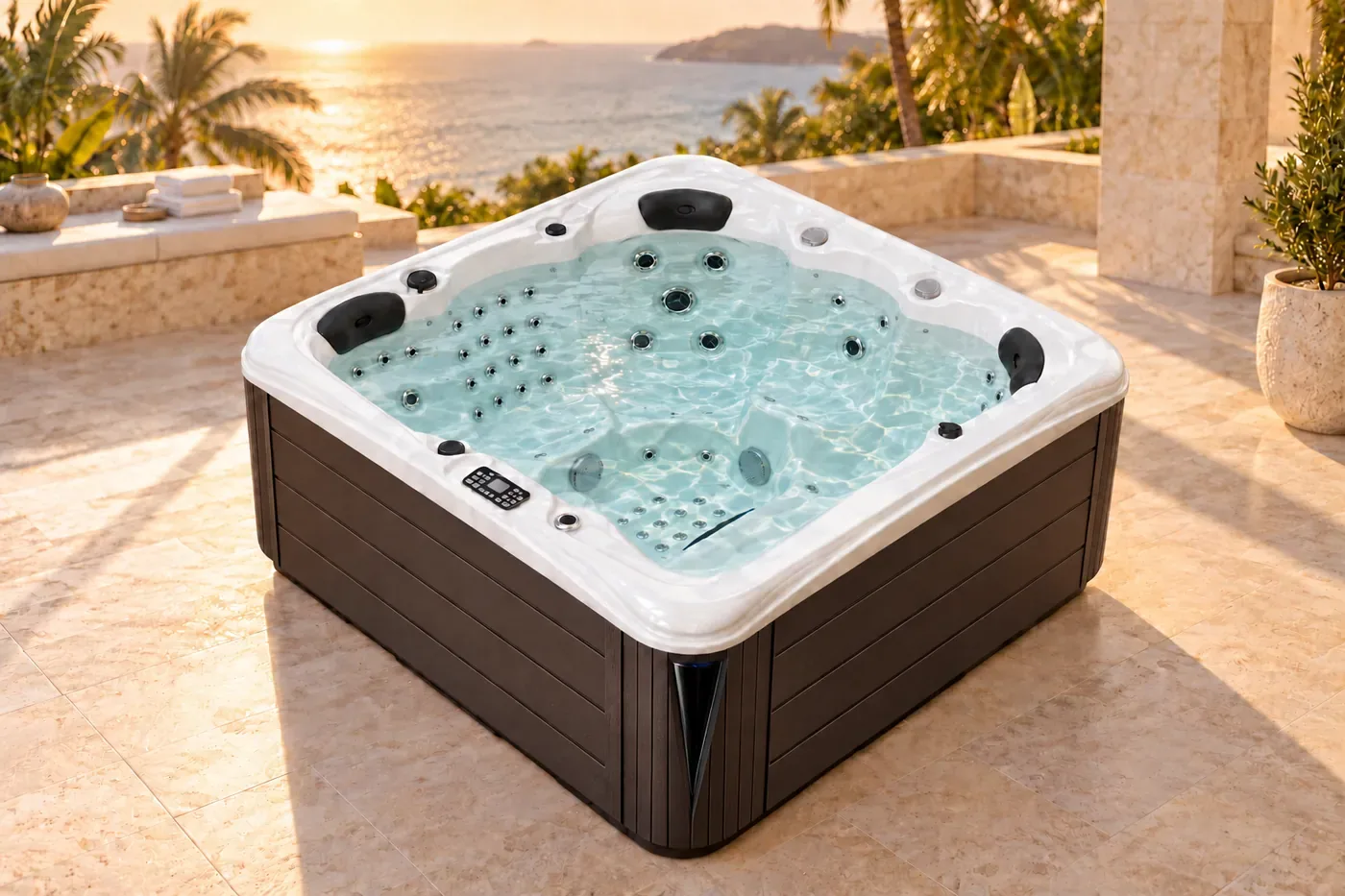
Where does a hot tub's electricity go?
A hot tub uses electricity for four very unequal functions:
- Heating. This is by far the biggest item. The heater, 3,000 W on most of our hot tubs (two 3,000 W heaters on the Ocean swim spa and the FX Pro), constantly makes up for the heat the water loses.
- Filtration. A small pump, from 250 to 750 W depending on our models, circulates the water through the filters for several hours a day, according to the schedule you choose.
- Massage. The massage pumps (often 1,500 to 2,200 W each) and the air pump are powerful, but they only run during soaks.
- The rest. LED lighting, electronic controls, optional UV lamp: a small share of the consumption.
In other words, it is not the number of jets that drives the bill, but the amount of heat to maintain.
How to estimate consumption
The basic calculation fits on one line: energy (kWh) = power (kW) × running time (h). A 3,000 W heater running for one hour uses 3 kWh. Then multiply by the price per kWh shown on your bill.
To picture the heat involved, a physical order of magnitude helps: it takes about 1.16 kWh to heat 1,000 litres of water by 1 °C. The first fill of a 1,000-litre hot tub, from water at 15 °C up to 37 °C, therefore needs around 25 kWh, or about 8 hours of a 3,000 W heater (theoretical calculation, not counting losses). A 450-litre hot tub like the Samana heats up roughly twice as fast.
After that, daily consumption is what it takes to make up for the losses. It depends on your region, the season, the exposure and how you use it: your advisor can give you an order of magnitude for your model and your situation.
The factors that change the bill
Outside temperature and wind. In winter, the difference between the water and the air is greater, and so are the losses. A hot tub exposed to the wind cools faster than a sheltered one.
Insulation of the tub. Many of our hot tubs are insulated with heat-reflective panels and have an insulated floor; the Fidji features triple insulation. When the manufacturer details it, the insulation is listed in the "Construction" section of the product page; otherwise, your advisor will tell you.
The cover. When the hot tub is open, the water surface is where it loses the most heat and moisture. A well-fitting thermal cover, closed after every soak, is the first way to save.
The set temperature. Every degree counts. If you go away for a few days, lower the set temperature rather than switching the hot tub off.
The volume of water. A 450-litre 2-seater and a 1,500-litre 7-seater do not have the same amount of heat to maintain. Choosing the right size also means choosing your consumption: see What size hot tub to choose.
How often you soak. Each opening loses a little heat, and the massage runs the pumps. Nothing to worry about, but it is what separates daily use from weekend use.
Eight ways to use less
- Close the cover after every soak, even for a short break.
- Shelter the hot tub from the wind: a hedge, a screen or a wall is enough.
- Schedule filtration and heating with the hot tub's controls, if possible during the off-peak hours of your electricity contract.
- Lower the set temperature when you are away; frost protection mode protects the hot tub in winter.
- Look after the filters: a clogged filter makes the pump work for nothing.
- Check the condition of the cover: a waterlogged cover insulates much less well.
- Avoid draining the hot tub in the middle of winter: filling and heating 1,000 litres of cold water is expensive. Schedule drains in the warmer months when possible.
- Set a suitable temperature: you do not need the same water for a relaxing soak as for a dip after sport.
Does a Plug & Play version use less?
A Plug & Play version has a single massage pump and fewer jets, so the massage uses less. But heating, which remains the biggest item, depends mainly on the volume of water, the insulation and the cover, not the number of jets. Plug & Play mainly simplifies installation: it plugs into a standard socket, with no dedicated circuit. See our budget hot tubs.
And in winter?
This is the season when a hot tub is enjoyed most, and when it uses the most electricity. Frost protection mode, available on most of our models, keeps the water and pipes from freezing. With the cover closed and the hot tub sheltered, the water stays hot from one soak to the next.
In short
A hot tub's consumption is controlled above all when buying (size, insulation, cover) and in use (cover closed, suitable set temperature, scheduling). To compare two models or estimate the consumption of your project, request your quote: an advisor will answer model by model.
 Buying a hot tub: 8 criteria for choosing the right one
 2, 4, 6-seater hot tub or bigger: how to choose the ideal one?
 Installing your hot tub step by step: slab, electricity, filling