
Where to install a hot tub: garden, deck, balcony, indoors or sunken?
In the garden, on a deck or a balcony, in a conservatory or sunk into the ground: every site has its requirements, to check before ordering. This advice applies to any outdoor hot tub, what many people call an outdoor Jacuzzi.
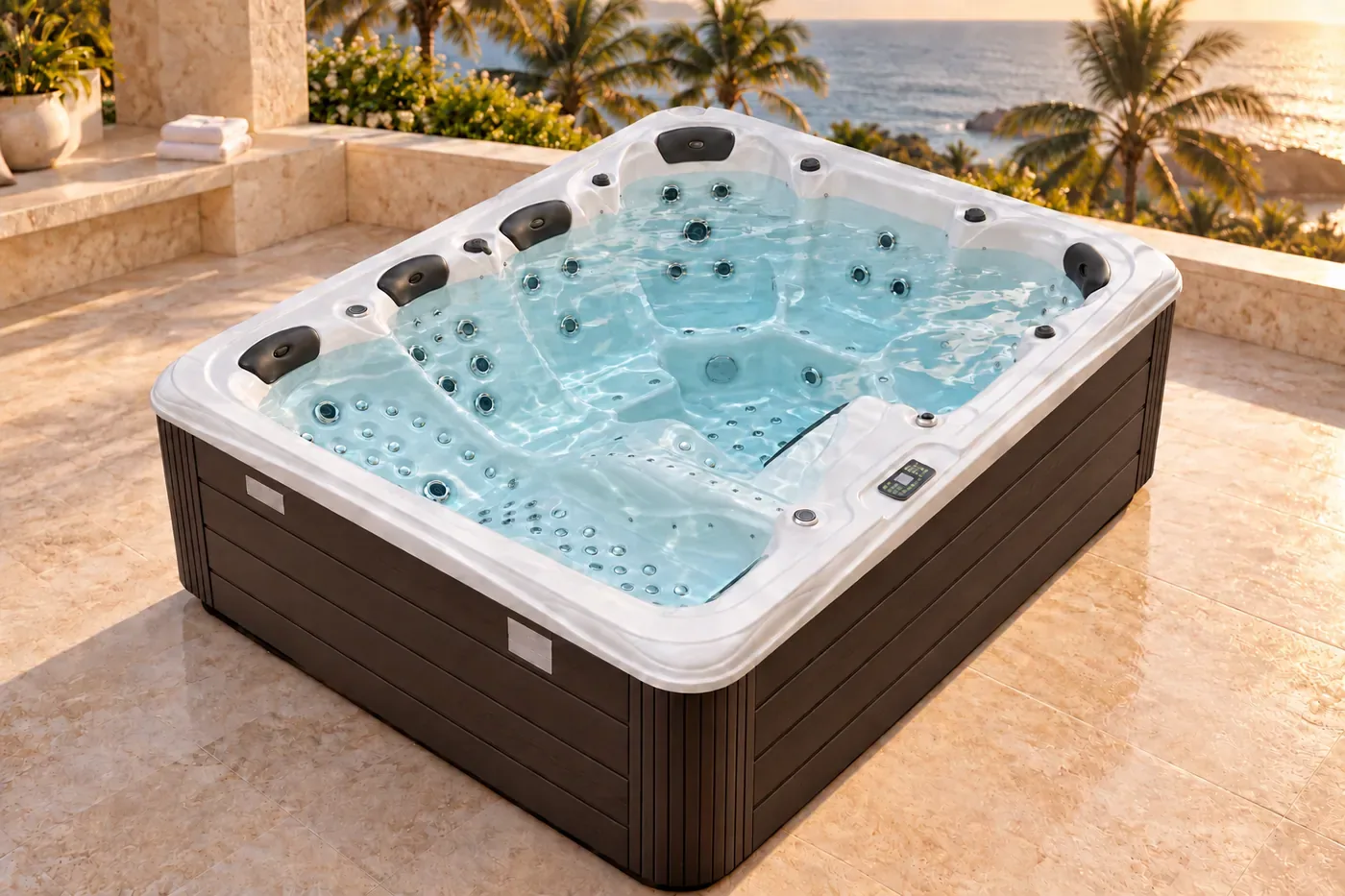
What a filled hot tub weighs
Everything starts with the weight. A filled hot tub weighs its empty weight, plus the water (one litre weighs one kilo), plus the bathers. A few examples from our product pages, before anyone gets in:
| Model | Empty weight | Water volume | Filled, without bathers |
|---|---|---|---|
| Calypso, 3 seats | 180 kg | 360 litres | 540 kg |
| Bahia, 4 seats | 400 kg | 900 litres | 1.3 tonnes |
| Acapulco, 6 seats | 450 kg | 980 litres | more than 1.4 tonnes |
| Santiago, 8 seats | 650 kg | 2,500 litres | more than 3 tonnes |
| Ocean, swim spa | 850 kg | 6,400 litres | more than 7 tonnes |
As our terms of sale point out: before installing a hot tub, have the ground surveyed, taking into account the hot tub, the volume of water and the maximum weight of the bathers.
In the garden, on a slab
This is the simplest site. A flat concrete slab, slightly larger than the hot tub and sized by a professional for the total weight, spreads the load over the whole surface. A lawn or soft ground is not suitable as it is: it settles unevenly under the weight.
Choose the spot carefully, too:
- wind: a sheltered corner keeps the heat in better and makes winter soaks more pleasant;
- trees: leaves, needles and pollen end up in the water and the filters;
- privacy: a hedge, a screen or a fence panel is often enough;
- the walk from the house: a hot tub close to a door gets used more, especially in winter;
- water: a tap nearby for filling, and somewhere to drain the water;
- the technical panel: keep it accessible, for maintenance as well as repairs.
Our terms of sale also require the PVC panels of the cladding not to be in contact with the ground.
On a timber or composite deck
This is possible if the structure is designed for the load: joists, pedestals and foundations must carry the filled hot tub and its bathers over its whole surface. A deck built for garden furniture is generally not. Have the permissible load checked by a professional before ordering, and the structure reinforced if necessary.
On a balcony or roof terrace
Here, checking is not optional. Have the project approved by a building professional, who will calculate whether the floor of the balcony or roof can carry the filled hot tub and its bathers. In a block of flats, also obtain the necessary permission before ordering. A crane is often essential to lift the hot tub: the official carrier you choose will say so in their offer. A compact hot tub, such as the Calypso at 540 kg filled, is better suited to this type of project than a large model.
Indoors: conservatory, pool house, basement
Some models are described as suitable for indoors and outdoors on their product page, such as the Fidji, the Bahamas, the Florida or the Romance. The room must be well ventilated, because hot water gives off humidity, and have a waterproof, level floor that can carry the filled hot tub, and a drain for the water. Also check that it will fit through the doors before ordering.
Have the room approved by a building professional: our terms of sale state that our hot tubs are designed for outdoor use, and that we cannot be held responsible for damage from an indoor installation (water damage, leaks, short circuits).
Above ground, semi-sunken or sunken?
By default, a hot tub sits above ground, on a flat base: this is the simplest solution, and the one that keeps the whole surround accessible.
A semi-sunken hot tub, or one built into a deck, needs more care. Our terms of sale set a simple rule: a hot tub must not be built in or buried without keeping access and a way to drain the water. In practice:
- keep access to the surround and the technical panel, through a hatch or a service space: the pumps, heater and plumbing are under the cladding;
- plan drainage for the bottom of the pit, so that rainwater or water from a leak does not stand around the hot tub;
- think about the day it has to come out: for a repair under warranty, the hot tub must be taken back to the place where you collected it;
- have the project approved by a building professional (groundwork, masonry, drainage).
Access for delivery
Measure the narrowest point between the lorry and the site: gate, door, path, bend, step. A hot tub often travels on its side: allow for its height plus a margin, and compare with the package dimensions given on most product pages. If the hot tub will not fit through, talk to the official carrier you choose: a crane lift can be included in their offer.
Electricity
Except for Plug & Play versions, plan a dedicated circuit installed by an electrician, with residual current protection. Your advisor will give you the cable size and circuit breaker rating for your model. For the warranty, the connection to the fuse board is made by a professional, with an invoice as proof.
Before ordering: the checklist
- The base is flat and carries the filled hot tub, bathers included.
- A professional has approved the deck, balcony, room or pit, where applicable.
- The narrowest point is wider than the package, or a lift is planned.
- The electrical circuit is planned, except for a Plug & Play version.
- There is a water point nearby for filling, and the drained water can run away.
- The technical panel and the surround remain accessible.
- In a block of flats, the necessary permission has been obtained.
The steps, in order
Once the site is chosen, all that remains is to prepare it and welcome the hot tub: base, electricity, delivery, filling. Our guide Installing your hot tub gives the steps and the timetable. For an opinion on your site, request your quote: an advisor will look at your project with you.
 Buying a hot tub: 8 criteria for choosing the right one
 Installing your hot tub step by step: slab, electricity, filling
 Hot tub maintenance: the routine, week after week